Adapter / Fast Connector, OPTICAL FIBER PRODUCT
SC APC vs SC UPC Fast Connector — What’s the Difference and Which One Should You Use?
Jul
If you are doing fiber optic installation in India, whether it’s an FTTH last-mile connection, a GPON subscriber termination or just a simple fiber joint, one question comes up almost every time: should I use SC APC or SC UPC?
Most technicians on the ground know what these connectors look like — one is green, one is blue — but not everyone is clear on why they are different and when to use which one. This guide breaks it down simply so you can make the right call on your next job.
What is SC UPC?
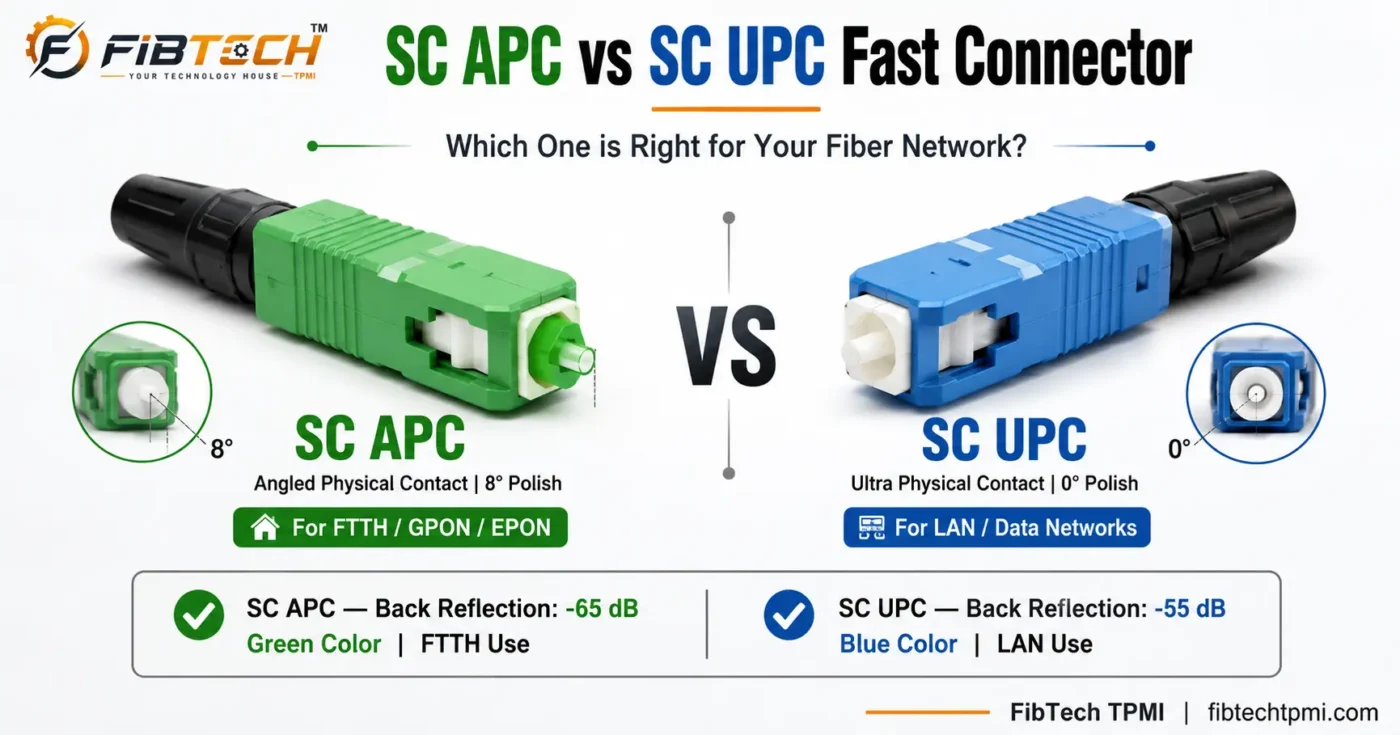
SC UPC stands for Subscriber Connector with Ultra Physical Contact. The tip of the connector is polished flat at a zero-degree angle. This gives a clean, low-loss connection that works well for most standard fiber applications.
The SC UPC connector is blue in color — that’s the easiest way to identify it on site. You will find it widely used in broadband distribution networks, indoor fiber runs and general data transmission setups.
If you are looking to buy, the SC UPC Fast Connector on our site is available in packs of 10 at a very competitive price, ideal for technicians doing multiple connections on a single job.
What is SC APC?
SC APC stands for Subscriber Connector with Angled Physical Contact. The key difference is that the tip is polished at an 8-degree angle. This angled polish reduces back reflection significantly — which is important in networks where signal quality is critical.
The SC APC connector is green in color — easy to identify and should never be mixed with SC UPC on the same link.
The angled design means light that reflects back from the connector face gets scattered away from the fiber core, instead of bouncing straight back into the transmitter. This results in much lower back reflection — typically around -65 dB compared to -55 dB for SC UPC.
You can check the SC APC Fiber Optic Fast Terminator Cold Connector available in packs of 20 — these are cold connectors, meaning no polish or epoxy is needed just insert and lock, making them perfect for fast field terminations.
SC APC vs SC UPC — Simple Comparison
| Feature | SC UPC | SC APC |
| Color | Blue | Green |
| Polish Angle | 0 degree | 8 degree |
| Back Reflection | ~-55 dB | ~-65 dB |
| Insertion Loss | Low | Very Low |
| Best For | Data networks, LAN | FTTH, CATV, GPON, EPON |
| Price | Slightly lower | Slightly higher |
| Compatibility | SC UPC ports only | SC APC ports only |
Which One Should You Use?
This is where most people get confused — so here is a simple rule:
Use SC APC when:
- You are doing FTTH last-mile subscriber termination in a GPON or EPON network
- The ONT or ONU at the subscriber end has a green port — which most modern ones do
- You are working with CATV over fiber where back reflection matters a lot
- The OLT or distribution equipment specifies APC connectors
Use SC UPC when:
- You are doing indoor fiber runs between switches, patch panels or media converters
- The equipment ports are blue — meaning they are UPC type
- You are working on a data center or enterprise LAN fiber connection
- Budget is a concern and the application does not need ultra-low back reflection
One Thing You Must Never Do
Never connect an SC APC to an SC UPC port or vice versa. The 8-degree angle difference means the fiber cores will not align properly. This causes very high insertion loss and can damage the polished end face of both connectors over time. Always match APC to APC and UPC to UPC.
Fast Connector vs Splicing — Which is Better for Last Mile?
For FTTH last-mile terminations in apartment buildings, individual homes or small offices, fast connectors are the more practical choice. You don’t need a splicing machine, no heat shrink, no consumables. Just strip the fiber, insert into the fast connector and lock it. Done in under a minute per connection.
Splicing is better for long backbone runs where insertion loss needs to be absolutely minimal, but for 1-10 metre drops to subscriber ONTs, fast connectors save a lot of time and cost on every job.
Browse our complete range of fiber optic adapters and fast connectors including SC APC, SC UPC and pigtail adapters — all available online with pan-India delivery at manufacturer pricing from Fibtechtpmi, Delhi.
